


- Written by: admin
- November 26, 2025
- Categories: Preschool Programs & Curriculum
- Tags:
If you’re a parent searching for the best playgroup in Chembur or wondering what exactly is the difference between nursery, LKG, and pre-primary, you’re not alone. Many parents find these early schooling terms confusing, especially since each stage plays a unique role in shaping a child’s foundational learning years.
In this blog, we’ll help you understand what each stage, Playgroup, Nursery, Lower KG (LKG), and Pre-Primary, actually means, what children learn at each level, and how you can make the right decision for your little one’s early education journey in Chembur.
Why Early Education Matters
Before diving into the differences, it’s essential to understand why early education is so crucial.
The first five years of a child’s life are when their brain develops the fastest. During this period, children absorb language, social skills, emotional control, and cognitive understanding like sponges. A well-designed early education program helps children:
- Develop curiosity and creativity
- Build communication and motor skills
- Learn to express emotions positively
- Prepare for structured school environments
That’s why choosing the right playgroup in Chembur or nursery in Chembur isn’t just about convenience, it’s about giving your child a strong foundation for lifelong learning.
Experience Basil Woods Before You Decide
Visit our campus to explore classrooms, interact with teachers and understand our nurturing learning environment.
Playgroup, The First Step into Learning
Age Group: 1.8 to 2.5 years
Focus: Socialization, independence, and basic motor development
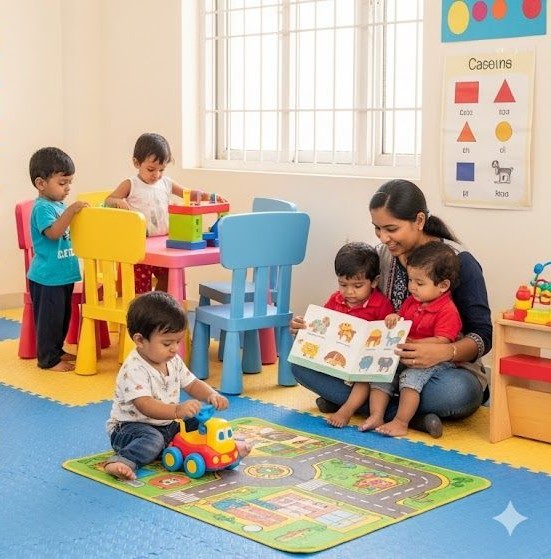
Playgroup is often the first step in a child’s educational journey. It’s designed for toddlers who are just starting to explore the world beyond home. At this stage, the focus isn’t on academics at all, it’s about helping children adjust to a group environment through play-based learning.
What Children Learn in Playgroup
- Recognizing colors, shapes, and everyday objects
- Developing gross and fine motor skills (running, holding, stacking, scribbling)
- Listening to short stories, rhymes, and songs
- Building basic social behavior, sharing, taking turns, saying “please” and “thank you”
- Getting comfortable away from parents for short durations
Classroom Environment
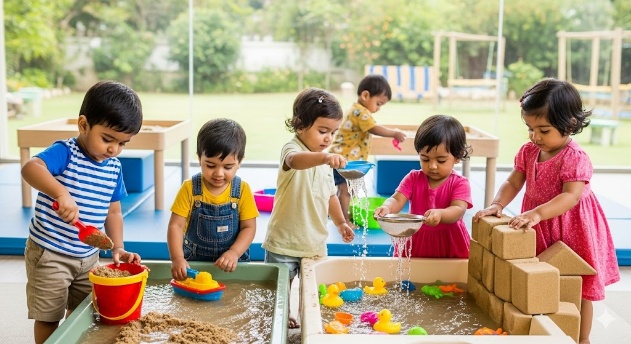
A good playgroup in Chembur offers a safe, cheerful, and stimulating space where learning happens naturally through fun. Teachers focus on routine-building and emotional security while introducing children to creative play, through activities like sand play, water play, art, and movement.
Pro Tip for Parents
When choosing a playgroup, look for low student-teacher ratios, clean classrooms, and a curriculum that emphasizes experiential learning over rote instruction.
Nursery, Building the Basics
Age Group: 2.5 to 3.5 years
Focus: Early language, sensory, and social skills
Once your child completes playgroup, the next step is nursery. Here, children start learning through more structured play and begin developing early literacy and numeracy skills in fun ways.
What Children Learn in Nursery
- Recognizing and tracing letters (A–Z) and numbers (1–10)
- ocabulary-building through stories, rhymes, and conversations
- Sorting, matching, and sequencing games to build logic
- Creative expression through drawing, clay modeling, and dramatic play
- Learning daily routines like tidying up and eating independently
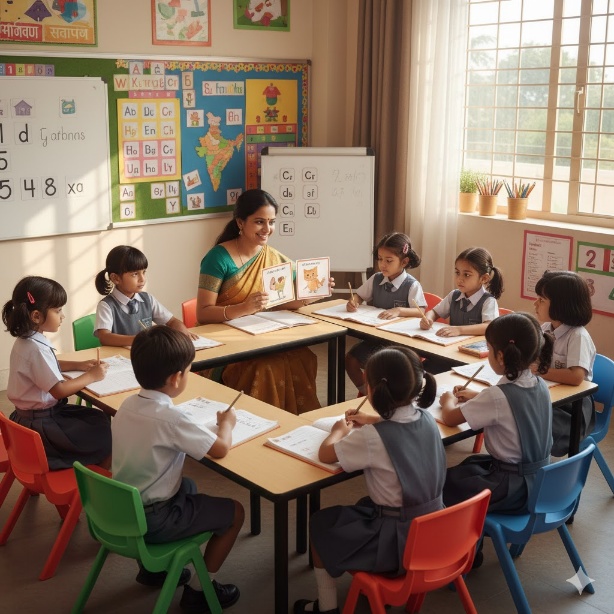
The nursery environment is more organized, with short circle times, storytelling sessions, and free play periods. Teachers gently encourage children to communicate, cooperate, and express themselves confidently.
Nursery in Chembur, What to Look For
A quality nursery in Chembur should offer a balanced curriculum, blending academics with creative arts and physical activities. The best schools often follow child-centric philosophies such as Montessori, Reggio Emilia, or Waldorf-inspired approaches, which nurture curiosity and independence.
Parent Tip: Visit the school personally and observe how teachers interact with children. Warm, patient educators make all the difference in these early years.
Lower Kindergarten (LKG), Transition to Structured Learning
Age Group: 3.5 to 4.5 years
Focus: Foundational literacy, numeracy, and conceptual understanding
By the time children enter LKG, they are ready for a more structured learning setup. The goal is to lay the foundation for reading, writing, and problem-solving while keeping the process playful and engaging.
What Children Learn in LKG
- Phonics and sound recognition (beginning to blend letters to form simple words)
- Pre-writing skills and pattern tracing
- Basic arithmetic (counting, sorting, comparing quantities)
- Understanding of time, seasons, and surroundings
- Introduction to moral stories and community awareness
Children also participate in group activities, music, and role play that develop communication and empathy. Teachers begin to assess learning progress gently, not through exams, but through observation and creative tasks.
Pro Tip for Parents
Ask whether the school follows Jolly Phonics or other modern reading programs, these help children develop strong language skills early on.
Upper Kindergarten (UKG) / Pre-Primary, School Readiness Stage
Age Group: 4.5 to 5.5 years
Focus: Preparing for primary school transition
This final stage of preschool education, often called pre-primary or UKG, bridges early learning with formal schooling. Children now have better attention spans, improved motor control, and strong curiosity.
What Children Learn in Pre-Primary
- Reading short sentences and recognizing sight words
- Writing letters, numbers, and simple words independently
- Performing basic arithmetic (addition, subtraction)
- Understanding science and environment through hands-on activities
- Learning social manners, teamwork, and responsibility
By the end of UKG, children are confident, self-reliant, and emotionally ready for Grade 1. The curriculum encourages inquiry-based learning, where children ask questions and explore answers through experiments and observations.
Pre-Primary Schools in Chembur
Chembur has several reputed pre-primary schools that emphasize holistic development, combining academics with art, music, yoga, and cultural learning. Parents often prefer schools with in-house programs that integrate global and Indian learning philosophies, preparing children both intellectually and emotionally for the years ahead.
Admissions Open for Playgroup to Pre-Primary
Get detailed information on fees, curriculum and the admission process at Basil Woods.
How to Choose the Right Preschool in Chembur
Choosing between playgroup, nursery, or pre-primary can feel overwhelming, especially with so many preschools in Chembur offering different curriculums. Here’s a quick checklist to make it easier:
- Curriculum Approach: Look for schools that follow Montessori, Reggio Emilia, or a blended pedagogy that promotes hands-on learning.
- Teacher-Child Ratio: Younger children need more individual attention; ideally, the ratio should be 1:10 or less.
- Safety and Hygiene: Ensure clean classrooms, child-safe furniture, and secure entry/exit points.
- Communication with Parents: Transparent updates and regular feedback sessions indicate a responsible school.
- Co-Curricular Activities: Art, music, storytelling, and outdoor play are just as important as academics.
- Emotional Environment: Choose a school where your child feels happy, secure, and valued.
Remember: The “best” preschool isn’t necessarily the fanciest, it’s the one where your child thrives, learns joyfully, and feels loved.
A Glimpse into Early Learning in Chembur
Chembur has emerged as one of Navi Mumbai’s most child-friendly localities, with well-planned infrastructure and a growing number of reputed preschools. Parents here have access to institutions that blend global learning methods with Indian values, offering structured programs from playgroup all the way up to pre-primary.
Whether you’re enrolling your toddler in a playgroup in Chembur or looking for a nurturing nursery in Chembur, the right environment can make a lasting difference. These formative years are about more than ABCs, they’re about nurturing curiosity, empathy, and the love for learning.
Final Thoughts
Each stage, Playgroup, Nursery, LKG, and Pre-Primary, is a stepping stone in your child’s developmental journey. Understanding these differences helps you choose the right starting point based on your child’s age, comfort, and readiness.
When you invest in the right early education, you’re not just choosing a school, you’re shaping your child’s future.
In short:
- Playgroup builds comfort and confidence.
- Nursery introduces basic concepts through play.
- LKG lays academic foundations.
- Pre-Primary (UKG) prepares for formal school life.
The nursery environment is more organized, with short circle times, storytelling sessions, and free play periods. Teachers gently encourage children to communicate, cooperate, and express themselves confidently.